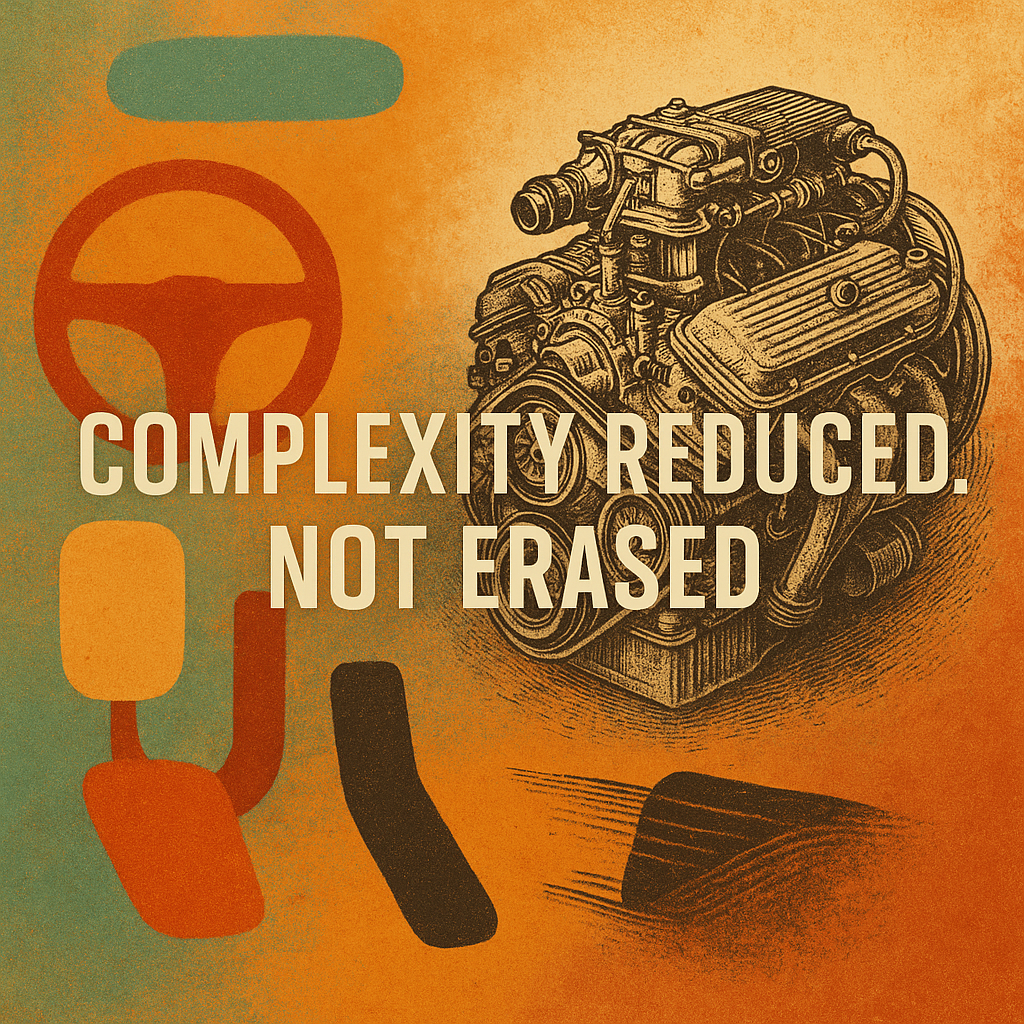
When you turn a car key, or press a button on the dashboard, you don’t think about the compression ratios of cylinders, the synchronized timing of spark and fuel, or the cascade of sensors reporting data back to the onboard computer. You think: the car starts.
That is abstraction.
But notice: the complexity hasn’t vanished. It sits there humming under the hood, absolutely essential. If the timing chain slips or the fuel injection falters, your abstraction collapses. What abstraction has done is reduce your burden of dealing with this complexity, without pretending it isn’t there.
This distinction is important: reduction versus concealment.
Abstraction is not a magician’s trick. It doesn’t sweep complexity away; it reshapes it into a usable form. The steering wheel, the gas pedal, the brake, these are agreements between human and machine. They let you focus on the actual problem the automobile is solving: getting from A to B.
If every driver had to manually synchronize pistons or regulate fuel-air mixtures on the fly, cars would not scale beyond hobbyists. Instead, we built a human-scale interface to an inhumanly complex machine.
And this is the real reason reducing complexity matters: it allows us to direct attention to purpose rather than mechanism.
The automobile isn’t about engines, or even about wheels. Those are means. The abstraction of driving, turn to steer, press to go, press to stop, frees us to engage with the end: movement, travel, connection.
The same logic applies to IT. Beneath today’s products, the machinery of cloud and DevOps is as intricate as an engine: servers, networks, containers, pipelines, security, scaling, monitoring. All of it has to run in concert. But most organizations don’t want to spend their energy micromanaging those cylinders.
Products like Multistax do for cloud infrastructure what the steering wheel and pedals do for driving. They don’t deny the existence of complexity; they shape it into an interface aligned with the real problem: shipping software, serving customers, moving faster.
In both cars and computing, the lesson holds: abstraction is not the hiding of complexity but the construction of a surface that allows us to focus on what matters. Movement, not mechanics. Outcomes, not internals.
The engine still matters. But you don’t need to hold the wrench to get where you’re going.